Sunday, 17 January 2016

Christmas 2015, Part 1

My husband and I decided to spoil ourselves this Christmas and give each other as a present a joint membership to the British museum and to the V&A. So just before the Christmas break we had a gorgeous day out at the British museum passing from one exhibition to the other and ending in the shop for some last minute Christmas shopping.

Celts, Art and Identity was engrossing. The stress of the exhibition was on the non-Mediterranean, independent and non-Roman identity of Celtic population (which is a very debatable point considering the fact that all we know about the Celts is from what Greeks and Romans wrote on them). It showed different beautiful artefacts testifying their mastery in metal work. The bracelets, torcs, shields and all the decorations for hilts and brooches were very original and unique. The figures of stylized plants, animals and people are a product of a dreamlike or idealized world rather than the study of reality. Their abstract sinuous shapes, interlaced lines that form complex knots and highly decorative patterns, are often described as abstract, a creation of the mind rather than a reproduction of facts. For this reason I find Celtic works inventive and extremely interesting, certainly communicating their mentality.
We know that they spread all over Europe and beyond but not as an organized group of people; they mixed with other populations, raided, sometimes settled and explored new lands, but never planned a proper conquest or an organized state-like structure similar to what the Mediterranean civilizations did, e.g. Egyptians, Greeks and Romans. We don’t know why this didn’t happen, possibly it was due to the harsh climatic conditions of central and northern Europe, notoriously colder than now, that didn’t allow much leisure as most part of the year it was mainly about basic survival. Or the fact that they were far from the areas where ancient civilizations started about six thousand years ago, Assyrian, Phoenician, Egyptian and Babylonian civilizations, in today’s troubled Middle East regions. On the other hand, Greeks and Romans were near to Egypt and the Middle East, they could trade with them and learn from them much more easily. Certainly it is difficult to dissert on philosophical matters or write astonishingly advanced tragedies like the Greeks did when you need to face long cold winters and food is scarce. With the Romans all the precious sophisticated knowledge that developed for thousands of years in the warm comfortable Mediterranean area spread all over Europe and mixed with whatever they encountered, and then mixed again with the German tribes when the Western Roman Empire collapsed. This crossing of different populations must have been hard, violent, sometimes ruthless, but this is how it was, and is, when people necessarily move, meet, clash, mix, creating who we are and will be.
The other compelling exhibition we visited was Egypt, Faith after the Pharaohs. I didn’t remember that Egypt (and the Middle East) was part of the Roman Empire, then Eastern Roman empire, from 30 BC till 7th century when the Arab armies conquered it, causing a large number of refugees. Jews, Christians and Muslims lived side by side in Egypt forming a rich melting pot society, their relationships were mostly peacefully with some tensions from time to time.
Before Muslim conquest, Alexandria was the capital and the language used by scholars was Greek while ordinary people spoke Coptic, which survived for four hundred years after the Islamic conquest. Ancient Egyptian, Jewish, Classical and Christian cultures merged leaving interesting objects like a statuette with the body of an ancient Roman emperor and the head of the Egyptian god Horus. The capital of the Byzantine Empire was Constantinople (the ancient Byzantium, today’s Istanbul) where, similarly to other parts of Europe, religion changed from the worship of many gods to one God.
On that same day we also visited another exhibition: Drawing in Silver and Gold, from Leonardo to Jasper Johns. It was close to room 90, Prints and Drawings, which I had never seen before. The exquisite drawings exhibited were made with a metal point (stick or sort of pencil), which could be gold and copper or silver and copper, on a prepared paper. They look like pencil drawings but the background is different and the tricky bit is that they can’t be erased. In this way the artists could affirm and prove their mastery of drawing techniques. The paper was prepared with some powder (e.g. bone ash) mixed with animal glue. This was brushed on the paper, sometimes mixed with a pigment (e.g. blue, pink, sienna )and once dry, it was marked with the stylus.
One of the best pieces of the exhibition is Leonardo da Vinci’s Bust of a Warrior, it shows all his skills and mastery of the demanding technique, which was very popular in Italy and the Netherlands during the Renaissance. Afterwards there was a revival in 19th century in Germany and in England. The last works of the exhibition are interesting pieces by Otto Dix, Bruce Nauman and Jasper Johns. The Untitled 1984 by Jasper Johns features plumbing fixtures with a jubilee vase in the middle outlined by the profiles of Elizabeth II and Prince Philip, on the background engravings of a whale, probably a reference to Moby Dick.
Definitely an intriguing technique I will try as soon as I can find a stylus and the right kind of paper.


Sunday, 20 December 2015

Cranberry time

I have recently bought a packet of plump scarlet cranberries to make plenty of sauce for the chilly nights coming, and I couldn’t help having a go at a cake as well. The result was glorious. Here is the recipe.

You need: 250 g of flour, 170 g of sugar, 70 g of butter, 2 eggs, 200 g of cranberries, 150 ml of water, one lemon, 2 tbsp of brown sugar, 100 g of dark chocolate, half a glass of milk, one and a half tsp of baking powder, one tsp of bicarbonate of soda and some grease proof baking paper.
First prepare the cranberries. Boil them in a pan with 150 ml of water, the juice of a lemon and 2 tbsp of brown sugar. Bring to the boil and cook for 5 minutes, then spoon them in a round baking tin (about 9 inches, 23 cm, diameter) lined with grease proof baking paper. Keep some of the juice of the cranberries.

Beat the butter in a bowl till soft and creamy, add the sugar and the yolk of the eggs. Then add the grated zest of a lemon, the flour, milk, the juice of the cranberries (about 3-4 tbsp), baking powder, bicarbonate of soda and finally the white of the eggs whipped stiff.


Mix well and pour the mixture in the baking tin. Bake for 30-45 minutes, 180 °C. When cool, turn it upside down on a plate and peel off the grease proof paper. Warm the dark chocolate with two tbsp of milk in a pan. When it is melted, pour it on the cake and let it cool. Serve with whipped cream....or (why not) cranberry sauce.

Sunday, 13 December 2015

My birthday cakes

I celebrated my birthday with two gorgeous cakes I shared with my colleagues and with my family. The two cakes are very different from each other but complement each other’s flavour in some way. Here they are.

Chocolate pear cake
You need: 200 g of flour, 100 g of sugar, 70 g of butter, 200 g of dark chocolate, 100 g of amaretti, 4 eggs, 100 ml of white wine, 2-3 pears, one and a half tsp of baking powder, one tsp of bicarbonate of soda. Icing sugar to decorate.
Peel the pears and cut them into cubes, boil them in white wine for 10-15 minutes or till soft. Mix flour, sugar, the yolk of the eggs and the melted butter in a bowl. Add the baking powder and the bicarbonate of soda as well. Melt the chocolate in a pan and beat the egg whites till stiff. Add all to the mixture together with the crushed amaretti. Pour half of the mixture in a greased tin and add the pear cubes, finally cover them with the rest of the chocolate mixture. Bake for 45 minutes, 180 °C . When it has cooled dust with icing sugar.

Apple tart with Philadelphia cream cheese
This is what you need.
For the dough: 300 g of flour, 2 eggs, 50 g of melted butter, 70 g of sugar.
For the cream: 350 g of Philadelphia cream cheese, one egg, 50 g of sugar, 2-3 apples, the juice of half a lemon.
For the top: 50 g of sugar, half a tsp of cinnamon.
First prepare the dough mixing all the ingredients in a bowl and kneading it. Let it rest for half an hour in the fridge. In the meantime cut the apples into quarters, peel, core them then cut into slices. Season the slices with the juice of half a lemon. Prepare the cream by whipping together the cream cheese, the egg and the sugar.
Roll out the dough and line a greased tin. Spread the cream on the dough and set the apple slices in rows or in a circle. Finally mix sugar and cinnamon and sprinkle it on top. Bake for half an hour at 180 °C .

Enjoy!

Sunday, 29 November 2015

Some books I read, summer 2015

Unfortunately I didn’t have much time to read because of the move. Nevertheless I enjoyed a few books, mainly Italian books this time.

I read three books by the same author, Cesare Pavese, that I found while I was unpacking the boxes and organizing the bookcases. They are: La bella estate (the fine summer), La casa in collina (the house on the hill) and La luna e i falo` (the moon and the bonfires). I also read a poetry pamphlet, Clay by Elizabeth Burns, a dear friend and exquisite poet who died last August.

La bella estate is part of a trilogy (the other two books of the series are Il diavolo sulle colline, The devil in the hills, and Tra donne sole, Women on their own). It was published in 1949, a definitely modern work for the time. The point of view is strictly limited to the protagonist (Ginia), a sixteen-year-old working class girl. The story is about her life, friends and loves, especially about her initiation to sex in a world of painters and models she is eager but afraid to join. Considering the setting (Turin before WW II, during Fascism), it is a very unconventional, edgy story. The way the protagonist describes her own feelings is rather demure, according to the conventions of the time. The contrast between what she says and thinks and what happens is crucial to the unfolding of the story. She follows her dreams, or instincts, ‘spoiling’ herself, as she says, with her fist lover, a painter. The urge to live, to become a woman is stronger than anything else. She starts a new life when the book ends, we don’t know if it will make her happy or doom her but it doesn’t really matter. The story is there, well-written, effective and open like life.

La casa in collina is a beautiful book centred on the life of a teacher involved in politics (but without taking direct action) during the final year of WW II in the north of Italy (Turin and the area of the Langhe, where the protagonist, and the author, comes from). The theme of finding a safe shelter (the house in the hills in his home village, hidden in woods, or a sanctuary, a church, where he can finally find peace) recurs throughout the whole story. The trouble of the civil war between Partisans and Fascists that raged in Italy during the last year and a half of WW II is the background of the story. The protagonist, Corrado, meets a group of Partisans at first but when they are arrested he manages to escape and takes shelter in a convent. His loneliness, his refusal to commit himself in the war or in a relationship, makes him live an existential problem. He can’t find the courage or the reason to change his attitude and his destiny. The fury of the fight and the thirst for blood seem to belong both to the Partisans and the Fascists. His only positive relation, with a boy he believes is his son, ends when he runs away and joins the Partisans, leaving Corrado alone with his remorse and pointless reasoning. The hopeless conclusion drawn by the book seems to be that there is no part to take, only wait for the storm to pass.

La luna e i falo` is the best of Pavese’s work. The book is so well constructed: the characters so vivid, the language new and rich, the story gripping, a true masterpiece. The story is set before, during and just after WW II and develops in a world of farmers where there is a clear class division between the rich owners and poor peasants who had barely enough to survive. Life was simple but genuine, a kind of life that was typical of that period in time all over Europe. The protagonist is an illegitimate child brought up by peasants in the Langhe (Piedmont hills). After the war he returns to his village from America, where he became rich selling illegal whisky. The frequent flashbacks to his life as a boy interweave with memories of the rich farmers’ family he used to work for. The narration is not necessarily detailed as it follows the protagonist’s thoughts; it often hints to sensations, outlines events, alluding to what had happened. The plot is superbly constructed, going onwards and backwards, maintaining the reader on the edge till the end. Sadness, disappointment, frustration, the urge to live life in full and ideals vs hypocrisy inevitably mix in a superb scenario.

Clay is Elizabeth Burns’ last pamphlet, she died last August of cancer but it didn’t stop her from working on her wonderful poems. She produced beautiful spare, poignant verves in this last book, most of them short meaningful poems. The central theme is the importance of cherishing the essential in life, taking care of what is inside the bowl instead of what is outside. The description of different vessels and pots, porcelain and china refers to the fragility and beauty of the material, precious but ephemeral. The extended metaphor of a vessel being equal to the human body develops in poem after poem. It is a bowl that contains the light of life, the energy that makes us human. The container can be enchanting, embellished with delicate spirals, enriched with corals, created with the finest clay, but it is still only a container. Its emptiness needs to be filled, replenished, as she says.

The last poem clearly refers to death, the bowls become urns for ashes, a reminder of the body and its spirit, now free for ever:
The bowl a small circle of sun
which will become
spring-light –


a hymn to everlasting life.

Saturday, 21 November 2015

October half-term 2015

My husband and I finally had our first holiday together during October half-term week, after more than a decade. It was only three days but it was fabulous. We had such a leisurely time thanks to the respite care centre that kept my autistic daughter Valentina during the week.


We planned to head north to see my eldest son who lives in Leeds, and my daughter who studies in Edinburgh. Instead of taking the train, we decided to drive to test our new car, a Passat, which I am quite scared to try because of all its electronic and automatic built-in devices.

The day we set off we took it easy, we got up late, had lunch, replied to the last emails and finally set sail in the afternoon thinking about a three-four hours journey at the most. But the traffic was horrendous and it took more than five hours to get to Leeds.

It was almost moving to see my eldest son after more than two months. It isn’t easy to spend time together as he graduated in July and is now working. We spent the whole evening in an Italian restaurant, Salvo’s, where he had booked a table. The restaurant was packed; a cheerful atmosphere of celebration filled the air, a clear sign of good food and good wine. The service was a bit slow though it was perfect for us, it gave us time to chat and update each other on family, jobs and friends. The food was exceptional; my son had a pizza called Buongiorno (good morning) with a poached egg in the middle. I chose some casarecce (short homemade pasta) seasoned with vegetables and goat cheese; my husband had a Francescana, pizza with ham and mushrooms. The best part was the desserts: cotognata (an apple jelly seasoned with cherries) with raspberry ice cream and an award winning panna cotta served in a glass bowl.

Before heading to the hotel we went to see my son’s small apartment in Leeds, two rooms where his belongings were freely scattered around, but it looked clean on the whole I must say, especially the kitchenette. We embraced and kissed good-bye, looking forward to meeting again for Christmas, hopefully.


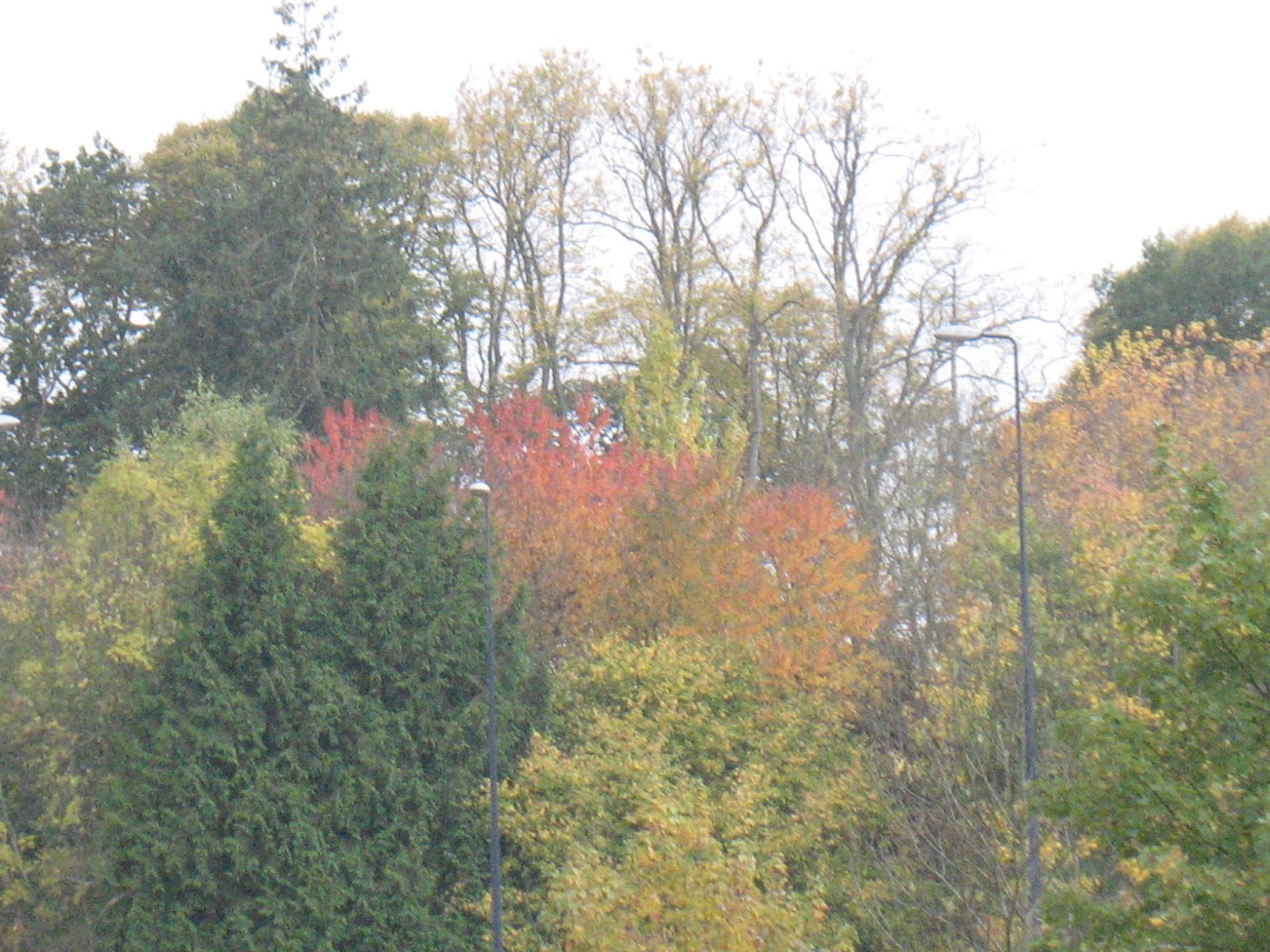
The next morning was foggy, the bends in the road towards Edinburgh barely visible. In Northumberland it cleared a bit and the beautiful view of autumn colours showed off in all its gold, reds and rusty hues. We stopped to take some photos.


Edinburgh was grey with vivid patched of colour from the fall trees. My eldest daughter spent some time with us to act as a guide along Princes street and the Royal Mile. I had planned to do my Christmas shopping: tartan woollen scarves (so many patterns and colours you are spoiled with choice), glittering cards and Celtic stuff. I also found pretty Scottish fairies in a market, Celtic crosses sewn on hand woven pieces of cloth, cute sloth and seal shaped silicone tea infusers that hang inside your mug, and original jewellery made with heather. While I was browsing shopping windows decorated for Halloween, I was overwhelmed to see Elizabeth Burn’s poem, Spiral, hanging from the scaffolding around the Scottish Poetry Library building. The Scottish poppy field of remembrance volunteers were preparing around the Scott Memorial, which was impressive too.


The weather was mild, dry most of the time with no wind, we were definitely lucky. We had our dinner at Amarone, an Italian restaurant in the centre, probably founded by Italians from the area of Verona (Amarone is a wine from Veneto). I had spicy tagliolini and chocolate semifreddo, all delicious.

On the second day we visited the National Gallery of Scotland. This time I didn’t miss the French Impressionists and the Scottish Art rooms (which were probably closed on my previous visit). I was impressed again by the two paintings by Salvator Rosa representing wild dramatic landscapes that reminded me of Ruskin’s work and by four embroidered panels I hadn’t seen before by the artist Phoebe Anna Traquair, based on Walter Pater’s Denys L’Auxerrois. They represent the soul’s progress (a sort of Bildungsroman in pictures) from a happy starting of hope and innocence (but also unaware of real life) to the gradual destruction of all illusions. After the third stage of total disillusionment, the ultimate redemption happens by chance, some unknown high power saves the poor soul without a specific reason or merit. An intriguing story, to say the least. I realized afterwards that Anna Traquair was very famous at her time, she decorated chapels and a Catholic church in Edinburgh as well as illustrating books and creating enamel jewels. Next time I go to Edinburgh I’ll see more.


Unfortunately the famous portrait of Reverend Robert Walker skating on Duddingston Loch was on tour around the world and they said it will probably be back in the summer. I’ll have time to see it next year.

At the museum shop my husband bought me my birthday present: a beautiful Alpaca green scarf and Art Noveau inspired earrings with a heather core.

Our dinner was at Ciao Roma, a typical Italian restaurant (all the waiters were Italian, which is rare), apart from a room named the Hispaniola, inspired by Treasure Island, with mannequins in pirate’s costumes and fish nets hanging from the walls. The food was superb: tagliatelle with salmon and saffron, cavatelli ‘nduja (handmade short pasta with hot salami tomato sauce), ravioli stuffed with provola (soft cheese) and aubergines. The ice cream flavours were unique (we found later on that it was award winning ice cream): Madagascar vanilla, peach and amaretti, sea salt caramel, Elderflower and raspberry yogurt, mascarpone amarena...we tasted as many flavours as possible and felt pleasantly full at the end.

The journey back home was long and busy but it was worth it.

Before starting school again, I had two days in Cardiff for business. It was a meeting of language and literature teachers from all over the world, very interesting and also great fun. We were hosted at Cardiff Hilton, which was exciting, as my usual travelling standards are Travelodge and Premier inn. The room was huge; the ceiling sky high, the bathroom was the size of an average bedroom and the bed could fit four people. Breakfast was fantastic, everything was there from full English breakfast, croissants, five kinds of bread, fresh fruit, fruit salad, dried fruit, fruit in syrup...I tried to taste everything but it was hard in only two days. There was also a gym and a swimming pool and the town centre was just round the corner. We didn’t have much time for leisure in between the meetings but I did find two pairs of ethnic earrings for my daughter in a market stall.

Apart from the fact that I got lost, having the wrong postcode on my sat nav and had to rely on unbelievably kind Welsh people for directions and rescue, it was perfect. The journey home was, of course, a nightmare.


Thursday, 12 November 2015

Art Books

Castle Park project: Lancaster Roman Bath House
My article and art book
Here are the products of my work for the Castle Park project, a lottery funded project launched by Lancaster Litfest in January 2013 (http://www.castleparkstories.org). I worked on the ruins of the Roman Bath House taking photos, researching documents and information at Lancaster Library and on line, and drawing sketches. The results are an article on the Bath House and an art book (photos attached) where I develop traditional drawings of the Roman ruins, decoration motifs taken from pottery and my personal, abstract view of the three main rooms of a typical bath house: caldarium,tepidarium and frigidarium. Read the article and look at the pictures of my art book to know more.
Lancaster Roman Bath House

The ruins of the Roman bath house are behind a railing near a 1970s grey concrete building. Its stones are partly hidden by dead leaves. There is an empty packet of crisps in a corner, a plastic bag behind a wall. It was part of a bigger building, maybe the commander’s villa or a hotel, and was used by the troops of the Roman fort, which was on Castle Hill.
            The Romans didn’t use soap but scented oils to anoint the body. The dirt, sweat and oil were scraped off by a slave with a strigil, or blunt knife. Afterwards they could take a bath in the frigidarium, a pool inside the same building. Terence, a playwright of the second century BC, wrote that one felt ‘perfumed and comfortable after a bath, your mind at ease (otiosum ab animo)’. Certainly, having a cool bath after a sauna is one of the divine things on earth.

            Bathing was vital for the Romans, it was a way to wash, keep clean, have a rest and also have a bit of leisure time. In the warm and hot rooms they could play board games or dice, drink and eat. Coins, dating 250-300 AD, were found in the hot room in Lancaster's bath house. It was an important part of their life so the walls were
decorated with painted plaster with geometrical green, red, yellow and brown patterns.
            In big cities like Rome, large public bath houses (thermae) were also a place to meet people, talk of art and literature, have a chat or clinch a deal. Everybody was naked so the rank or social class (often linked to clothes and uniforms in Roman time) wasn’t clear. People mixed, had fun, maybe had sex or got drunk and eventually were clean. Emperors could grant free entrance to the baths and free oil to win the favour of the populace. And though having a bath every day was considered immoral and could weaken the body or soften the character, having a private bath house meant wealth and success in business, ‘for healthy men wash themselves even when it is unnecessary.’ (Artemidorus)


            It was probably built during the period of the emperor Trajan or Hadrian (second century), when the empire was at its apex and had reached its greatest territorial extension. The walls of the two main rooms are still clearly shaped: the tepidarium, or warm room, and the caldarium, or hot room. Parts of the furnace of the hot room is visible as well as the stone pilae that supported the floor. The fire burning in the furnace heated the rooms; the caldarium, which was above the furnace, was like a sauna, unbearably hot but tremendously relaxing, especially for a soldier who had his watch in the bitterly cold and windy weather. It must have been an immense relief to lie in a properly heated room and finally take their ease.

Creative Journal, part 1
My autumn art book.
This year I attended a fantastic art class at Dallam school (http://www.dallam.eu/community/2510.html) with Janette Phillips (http://janettephillips.com/). We  explored creative journaling, which sounds like writing, but instead is creating your own journal using collage, drawings and photos and collecting meaningful items. It was a great opportunity to explore my creativity and use different techniques in painting and drawing, with which I experimented throughout the two terms of the course.
The tutor gave us a rich source of prompts and showed us books with examples, new materials, ideas and guidelines. Finally I was completely free to create whatever I liked, which was exciting and extremely challenging. The tasks were not easy or straightforward and we had homework to do every week, but I could really follow my obsessions, mix techniques and make my own books.
In the autumn term I worked with mostly leaves. I must admit it is one of my passions: the colours and the textures, the symbolism of fallen leaves is something that inexorably attracts me every year. I collected and painted loads of autumn leaves using and mixing different techniques. I used watercolours, coloured pencils, wax pastels, pastels, Brusho, washable wax pastels and ink blocks, felt pens and inks.
We then used collage and contour drawing (a technique used to sketch the outline of an object without looking at your drawing and without stopping) and we made our own books. I created a small booklet inspired by fallen leaves and a Christmas book inspired by my Christmas holidays in Rome (which I already posted in this blog in January).
The photos attached portray my work, starting with a collage, a small booklet with leaves, a page inspired by a visit to the Walker Art Gallery in Liverpool, more leaves with mixed media, the contour drawings of my watercolour palette and a vase with dried flowers and finally my plan for the cover of the Christmas book.
By the end of the autumn term I didn’t have anything to hang on my walls (which are already full) but I acquired a lot of experience and produced some highly original pieces.

Creative Journal, part 2
My winter and spring art book.
Throughout the winter (officially the spring term,though we didn’t have much spring weather before Easter this year) we carried on with our creative journal, focusing on lettering, collections and image transfer. During the last sessions of the course we developed our own projects.
At first we created a page using prompts from a dice or cards (e.g. collage starting with a small image from a magazine, adding white, drawing what is in front of you, etc), which I did drawing a bottle of Sprite and using some white materials and pale colours that reminded me of the weather and landscape of last winter. For the lettering I experimented with the Roman alphabet, trying to make it more flexible and weird (which is hard work with ancient Roman things) and planned my book on Lancaster Roman Bath House for the Castle Park project.
The next stage was to illustrate a poem or a phrase. Fantastic! Just my thing. I chose a poem, of course. I chose Fall by Andrew Motion, from his last collection The Customs House. It was such a deep experience to write each line of the poem again and again using different inks, making the words resound inside me and interpreting the poem at the same time. I realized that illustrating a poem is also a way to understand in depth, making it meaningful.
I drew and painted some buttons for my collection theme, using mixed technique. I also drew an evening sky with washable felt pens and created my ideal living room with famous paintings on the wall (Turner, Morandi, Elizabeth I and Hockney). It would be worth millions!
For the image transfer I used a picture of the Duchess of Cambridge from a Woman’s Weekly cover and painted on it with watercolours. I like the way the final result is colourful and textured, but clear enough to recognize Kate. I also experimented with a coloured background and transferred the image of trees and flowers. I worked on it again, using black ink this time and adding a poem I love: The fenced wood by Jean Sprackland, from her collection Tilt.
Finally I planned and worked on my final project: an art book of my favourite poems. After a long, hard time choosing I selected about forty poems in English, Italian, French and Spanish, rolled up my sleeves and started the work of illustrating each of them in a page of my new art book. Next in this blog.

My poetry art book

How I linked poetry to art.
I started to illustrate my favourite poems a few months ago after an art course about creative journals, held at Dallam School. The tutor, Janette Phillips, encouraged us to plan an art  book project centred on our own interests. I chose poetry, of course.
My first poem was by Andrew Motion, Fall, from his last collection. I went on to choose poems from the poetry collections on my book shelves. This was an excuse to indulge even more in one of my favourite activities, reading poetry, and a great opportunity to link two things I love: poetry and art.
I finished the first art book during the Easter holidays, illustrating more than thirty poems from W.H. Auden, J.L. Borges, Eugenio Montale, Alda Merini, Charles Baudelaire, Jean Sprackland, Pascale Petit, and many from poets in the north west.
At present I am working on a second art book of poetry, as I have so many favourite poems that one art book was not enough. I am also illustrating my own poems, which is more challenging in some ways.
When I choose a poem to illustrate, it is because it has moved something in me, something visual. Reading it, my mind shapes images, colours burst out and the poem takes a life of its own. I suppose there is a similar relation, in sound, between poetry and music.
My pictures aim and aspire to interpret the poems, to complete them in some way, and make them more interesting. It is more difficult with my own poems because I need to be detached from what inspired me in the first place and to treat them as if they don't belong to me. The advantage in illustrating my own poems is that I don’t need permission to put them on my blog!
Here are four poems from my first Art Book of Favourite Poems:
Butcher by Carole Coates (Swallowing stones, Shoestring Press, Nottingham, 2012)
Making the Moon Jar by Elizabeth Burns (Held, Polygon, Edinburgh, 2010)
Echo Sounding by Sarah Hymas (Host, Waterloo Press, Hove, 2010)
What the Water Gave Me II by Pascale Petit (What the Water Gave Me, Seren, Wales, 2010)
Many thanks for permission from the authors above to publish their work on my blog.

Butcher
the butcher came to our home
with his big scissors and his knife
and four aunts to hold me down
he sliced me and trimmed me
all the place between my legs
carved out, scraped to the bone
(Carole Coates)
I illustrated Butcher drawing a simple pair of scissors with a clear traditional shape, making no compromise in its cruelty, because this is what the poem revealed to me. I chose pencils and kept it black and white to outline the appalling reality it shows.


Making the Moon Jar
To make a jar as perfect as those from the Choson dynasty
– enormous rounded vessels used for storing grains of rice –
The potter must learn patience. Over and over again,
what emerges from the kiln is cracked or buckled, weak
at the circumference. Another one, flawed and unglazed,
heaved onto the truck, taken down the truck into the woods,
where she smashes raw white pottery to bits and buries it.
Back in the studio, her hands shape into being two new hemispheres,
slippery as newborns. She balances one into the other, smoothes
wet clay between them, makes them whole. First firing, no cracks yet –
she deeps the vessel in a milky glaze. Another firing, then
the opening of the kiln-mouth, the lifting out: a full moon jar.
She moves around it, strokes the pearly skin of porcelain,
feels the slight ridge round the centre, an equator. Two halves
are joined. Her heart is singing at what her hands have made.
(Elizabeth Burns)
Making the Moon Jar is such an involving poem, leading the reader to the final surprising product, an object of art in itself, round, simple and perfect. I used pastels to draw the jar and accentuate the stark contrast between the white shape and the dark background. I wrote the poem on the jar because the poem creates the jar.


Echo Sounding
Light glosses over tidal streams,
hiding our deepest valley, highest mountain.

Through the gale force and iron stillness, the albatross
circumnavigates yearly, mates for life.

Imagine weeks of greys and blues, slate, silver, sky,
rocking to stay vertical.

Without wind to tauten polyester and rope,
sails are like sextant without sun.

Despite the light and dark there is no night or day,
just three hours shifts, off and on.

the swell breaks on deck. I’ll never
rinse this salt from my ears.
(Sarah Hymas)
Echo Sounding is so evocative: it breathes in the wind, opens vast blue skies and boundless seas. Painting the sky and the sails, I chose the lightness and transparency of watercolours mixed with ink to convey these qualities.


What the Water Gave Me II
The water opened
into the vortex of my daughter’s face.
Her skin was a rippled mirror.

She was wearing the bath around her
like a dress of glistening scales.

She was my fish-flower.

I floated on her tongue
like the word ‘Mama’.


(Pascale Petit)
The words in What the Water Gave Me II inspired this picture: a face with vaguely Asian features surrounded by marine creatures. I used watercolour pencils, which gave me the opportunity to draw details and keep the picture light and loose. It shows a mythical figure emerging from the poem itself.


I completely enjoyed the project and decided to exhibit all my art books at Silverdale and Arnside Art and Craft Trail on 28th, 29th and 30th June in Silverdale School (http://www.silverdalearttrail.co.uk/) together with my paintings on fabric, scarves, masks and jewellery.
Come and see the Trail!