Saturday, 29 February 2020

Spring is on the way

I was very happy to go back home after my Christmas holidays in Italy. I had had my break and a good time with friends and family. I was ready to return to my routines and relax for a few days before starting to work again on my thesis and at UCA Farnham. As soon as I arrived home, I unpacked the luggage, did some laundry and reorganised my book shelves, reviewed files, blog posts and knitting work. Cleaning my Fiat 500 was also a priority, and hard work, as it was in miserable conditions probably due to my travelling around Surrey. I caught up with emails and did the supermarket shop as well. I found some cranberries and Seville oranges at the greengrocer’s so I experimented a new cake and made marmalade (recipes here below).

I soon went back to my studies focusing on my thesis and on two presentations I delivered at the end of January. One was at the University of Reading on the Edible woman, Reshaping the body: symbolic anorexia in The Edible Woman by Margaret Atwood, for the Gender and Sexuality Research Network’s Seminar Series; the other one was at the Centre for Myth Studies at the University of Essex on Intertextual references and myths in The Handmaid’s Tale

(https://essexmyth.wordpress.com/2020/01/26/intertextual-myths-handmaids-tale/ ). They were both enthralling experiences with riveting discussions at the end of the sessions that gave me new ideas for my thesis. My article on cannibalism in The Edible Woman was published on the review Exchanges (University of Warwick) in January as well, here is the link: https://exchanges.warwick.ac.uk/article/view/446


We managed to see the pantomime too at the New Victoria Theatre in Woking as soon as we came back from Italy. It was performed according to the best tradition with the ventriloquist, the twelve days of Christmas and the five toilet rolls tossed here and there, usually among the audience, a man
dressed in woman’s clothes (Aladdin’s mother) and Strictly Come Dancing dancer, Brendan Cole. Bobby Davro was amazing; he imitated the voices of celebrities and politicians, including President Trump, and though there were a few weird jokes, it was great fun. I love the way the audience is involved in pantos, it is pure entertainment as it should be, and according to Brendan Cole, Strictly is a panto too. At the end of the story there was a final twist when Aladdin was knocked out by the sorcerer and Jasmine took his place fighting against the villain and winning. Fantastic!

With the new year, I realised that my hair has definitely changed and my body has changed too. I don’t know how, but my hair has become curlier, almost crispy. I thought it was the shampoo or the fact that I go swimming once or twice a week. I changed shampoo and used more conditioner and hair oil but there was no change. Then I thought it was the English weather, particularly humid this year, but when I went to Rome for Christmas for two weeks my hair kept the same shape, only the
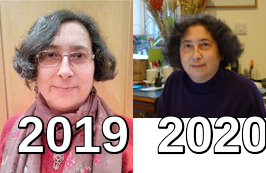
hairdresser managed to straighten it. My hair has never been like spaghetti but it was far straighter just a year ago, and I have photos to prove it. Maybe it is that it became thinner with aging. It does not look so bad after all and it fits my face that has become larger; it seems as if I got a perm.

My body has changed too. I get tired more easily and if I want to keep active, I have to balance my activities. Therefore, I do my ‘intellectual work’ in the morning (PhD work and writing) or early afternoon leaving house chores, crafty stuff, knitting and crochet for the late afternoon and evening. Reading, creative writing and reviewing are my happy breaks. My legs and arms are still thin but my waistline has become suddenly larger and though I exercise it doesn’t seem to go back to how it used to be. Finally, my back aches and I have to rest or do some exercises the physiotherapist recommended to ease it. It is not a nightmare but I need to adapt my lifestyle to my new conditions.

I take breaks from time to time from my studies to recharge my brain and also to go back to my thesis with fresh eyes. Starting a new creative project always helps me. Bags, scarves, a new Halloween dress for my daughter Valentina, or granny squares, give me a relaxing interval and fuel my creative side. I work as well as an academic mentor at UCA Farnham, that is, I support students in their research and in delivering their work on time. It is a rewarding job that gives me money and also keeps me in contact with the academic world and with university students.

Lately, I started to draw and paint again attending Chobham art group and Woking Art Society’s meetings and workshops. I have worked with all kinds of media in the past since I was a teenager, from tempera to oil, acrylics, watercolours and mixed media. Since I came to England, I especially developed watercolours and mixed media, which I love, using intriguing new products and techniques. It is a rewarding and relaxing activity that also gives me the opportunity to meet people that share my same interests, but it is a commitment as well that needs focus and dedication on a certain project you decide to carry out. For me at the moment it is mainly drawing and painting leaves and flowers though in the past I also painted shells, stones, still life and landscapes. There will be opportunities for exhibitions in Woking and in Surrey area in spring and summer and I hope I will have enough good pieces to display.


In line with my artwork, I am also planning to take part in art and craft fairs to fund my summer journey to Canada and my son’s fundraising for VSO (Voluntary Service Overseas). He will sell his origami and artwork and I will sell my jewellery, handmade clothes and bags, scarves, knitting and crochet stuff, as well as my artwork. Here are the fairs I am going to attend:

Friday 28th February: Kenley Market, Kenley Memorial Hall, Kenley CR8 5AB, from 8 until 12.

Friday 20th March: Kenley Market, Kenley Memorial Hall, Kenley CR8 5AB, from 8 until 12.

Saturday 25th April: Guildford Guildhall, Guildford GU1 3AA, from 10 until 5.

Saturday 2nd May: Cranleigh Village Hall, Cranleigh GU68AF, from 10 until 4.

You can also find all the information on my website here: http://www.carlascaranod.co.uk/?Readings_%26amp%3B_Fairs

At half term we celebrated my husband and my daughter Valentina’s birthdays. We travelled north where Vale lives, met my eldest son and daughter in law in Leeds and had a cosy party with Valentina in Fullerton. It was great fun. We had prepared a Futurama theme party with pictures of the purple haired Leela and clothes for Vale with Leela printed on. She loved it. She showed off all the clothes and stuck Leela’s pictures on walls and windows. She also drew Lela again and again on a roll of paper and watched Futurama videos. The social services told us they will move Vale south at the end of March in the Redhill area as she is an adult now (she is twenty) and cannot stay in Fullerton any longer. We are happy about the move as she will be nearer to us, about an hour drive, so we can see her more often and spend more time with her.


In Leeds we went to a new pizzeria, Livin’Italy (https://livinitaly.com/ ), an exciting place. We had intriguing cocktails, such as Italian Stallion, Sbagliato, Sardinian Millionaire and Eager Porno Star Martini, and excellent huge pizzas (20”) we shared, and finally delicious artisanal gelato (ice cream). A cool place with superlative food.
 

The weather has been very windy and rainy this year but daffodils and crocuses are poking out as ever and some trees have white and pink flowers defying the gale. The risk of coronavirus lingers which seems worrying (we have planned a trip to Tokyo to see my daughter’s MA graduation at Bunka Gakuen University) but let’s hope that all will end well and spring will come at last with mild sunshine and new treats for this challenging year.


And here are the recipes:

Cranberry cake

You need: 250 g of white flour, 100 g of sugar, 2 tbsp. of cranberry sauce, 80 g of melted butter, 2 tsp of baking powder, 2 eggs, 50 g of dark chocolate chips; to decorate: cranberry sauce and 100 g of melted dark chocolate.


To prepare the cranberry sauce you need to boil the cranberries with some water, Demerara sugar and a stick of cinnamon. For the cake, beat the eggs and the sugar, add all the other ingredients and bake for half and hour-45 minutes at 180°C. When it cools, melt the dark chocolate in the microwave and pour it on top, then add one or two tbsp. of cranberry sauce.

Marmalade

You need: 1 ½ kilo of Seville oranges, 1 kilo of sugar.

Boil the oranges for one hour. Keep half of the water. Peel and scoop the pulp of the orange removing the pith and pips. Chop half of the peels then simmer the pulp, peels and water for 1-2 hours or until it is ready.


Superb!

Saturday, 15 February 2020

Recipes from Rome


I experimented new recipes with my mum in Rome as usual. They were for the Christmas festivities but are good all-over winter time. Here they are:

Cake with ginger and dark chocolate

You need: 300 g of flour, two eggs, 100 g of Demerara sugar, 100 g of melted butter, one and a half tsp pf baking powder, one tsp of bicarbonate of soda, one tbsp. of ground ginger, 200 g of yogurt or four tbsp. of milk. To decorate: 100 g of dark chocolate, 75%, the peel of an orange, half a tsp of ground ginger and one tsp of Demerara sugar.


Warm the butter with the Demerara sugar and the ginger. Beat the eggs and add all the other ingredients together with the butter and ginger mixture. Stir until you obtain a smooth mixture. Pour the mixture in a greased round tin cake and bake at 180℃  for half an hour or until ready. Let it cool and prepare the decoration melting the chocolate with 10 g of butted and a tbsp. of milk. Cover the cake with the chocolate mixture and let it cool. Cut the peel of the orange in small pieces and boil it with two tbsp. of water, the ground ginger plus Demerara sugar. Let it boil for 10-15 minutes then decorate the top of the cake with the orange pieces and pour some of the water on the cake.

Small panettone

You need: 400 g of flour, two egg yolks, 50 g of raisins, 50 g of mixed peel, the zest of an orange, 50 g of melted butter, 50 g of sugar, 12 g of dry yeast, a pinch of salt.


Soak the raisins in warm water and some drops of liquor (optional). Beat the eggs with the sugar, add the melted butter and the rest of the ingredients. Add the raisins and the warm water as well. Knead the dough and cover it with a wet tea towel. Let it rest in a warm place for two hours.  Knead the dough again, divide it in small portions and place them in paper cases. Cover the cases with film and let it rest in a warm place for an hour. Bake at 180℃ for half an hour or till ready. Dust with icing sugar to finish.


Special carbonara

For four people you need: 400 g of fresh egg tagliolini, 100 g of prosciutto, 30 g of butter, four tbsp. of parmigiano, 150 g of double cream, black pepper, four eggs, some gin or cognac.


Cut the prosciutto in pieces and sauté it in a frying pan with the butter. Add the double cream and the liquor, let it simmer for a few minutes. In a bowl beat the eggs with the parmigiano and pepper. Cook the tagliolini in salted water. Drain them when ready keeping some of the water. Pour the pasta in the frying pan and add the beaten eggs and some of the water. Stir and mix the tagliolini until the eggs are cooked and serve with extra black pepper and parmigiano.

Spaghetti alla bottarga

A friend of mine, who is originally from Sardinia, prepared a special treat for me and my mum when we visited her. It is a simple delicious recipe with a Sardinian ingredient: bottarga di mugine, that is, the eggs of grey mullet.


For four people you need: 20 g of bottarga di mugine, three pieces of garlic cloves peeled and chopped, extra virgin olive oil, 300 g of spaghetti, fresh parsley.

Cut the parsley thinly, warm the oil in a frying pan and add the garlic. Let it simmer for 5-10 minutes without burning it. Add 15 g of bottarga, stir and turn off the heat. Cook the spaghetti in salty water and drain them. Add the bottarga sauce, the rest of the bottarga and the parsley. Serve warm with more fresh parsley on top.

My Sardinian friend also prepared special raw artichokes cut in pieces and seasoned with extra virgin olive oil, bottarga and shaves of parmigiano, it was delicious!

Some treats from Moldavia

My mum’s carer, Tania, is from Moldavia. She prepared a treat for us that they always make in Moldavia for festivities. We call it insalata russa (coleslaw or egg salad), Olivie in Moldavian. To have a successful dish, the secret is in balancing the doses of the different ingredients. She also brought a cockerel that we boiled to make chicken broth for our evening soup adding pastina (little pasta in the shape of stars or small squares).


Olivie (coleslaw or egg salad)

You need: three potatoes, three carrots, six small pickled cucumbers, four hard boiled eggs, one pepper, half of a chicken breast or some salami, salt, pepper and mayonnaise.

Boil all the ingredients except the pepper, salami and pickles. Cut all the ingredients in cubes and mix them. Add salt, pepper and mayonnaise. Mix well and chill for one hour before serving.

Brodo di gallo

Cook the cockerel in water with one peeled onion, a potato, a carrot, a stalk of celery and a tomato. Add salt and let it simmer for one-two hours. Cook the pastina in the broth and serve warm with parmigiano.

Enjoy!


Friday, 31 January 2020

Amazing Naples

I spent one day in Naples with my husband, my parents in law and one of my boys. The trip is only one hour by train from Rome, very comfortable with Frecciarossa and Italo. It was a warm sunny day; Naples’ recently renovated railway station is modern, clean and welcoming, included the toilets, though a bit expensive (€ 1). The underground was spotless and looked new as well. The National Archaeological Museum was efficiently organised, though I found the captions a bit cryptic sometimes.

Visiting Naples was riveting and fascinating. The city has so many faces, all interesting, revealing cultural, artistic and social diversity that have been layered throughout centuries, as Pino Daniele brilliantly sings: https://lyricstranslate.com/en/napule-%C3%A8-naples.html. This is well explained in the Museum with artefacts that date from the 4th century BC. Unique Attic black amphorae illustrating Greek myths, helmets and gold jewels from Magna Graecia time were on display as well as Roman statues, some of them copies of Greek originals. There were statues and bronzes rescued from the sea near the blue grotto of Anacapri and at Punta Licosa. At the entrance hall a beautiful Neapolitan Presepe welcomes the visitor. It is circular showing the activities and products of the region with the nativity on top. The Presepe in Neapolitan tradition not only represents the nativity, it reveals an identity that mingles culture, art, religion, agricultural production and food of the region. It is an artistic expression appreciated by all social classes from aristocracy to ordinary people.


One of the most interesting pieces was Atlante Farnese, a copy from a Greek original, who holds the earth on his back, one of the most ancient representations of the earth and sky with the constellations in relief. Among statues of Venus Kallipygos or Callypige, Hera, Ercules and busts of emperors there was the exhibition of contemporary sculptures in metal work by Riccardo Dalisi. He is an artist born in Potenza in 1931 who worked both at the Faculty of Architecture at the University of Naples and with young people at the rough Rione Sanitá in Naples. His approach aims to establish a dialogue between design, sculpture, craftmanship and painting. It is a very creative work, surprising, unconventional, commenting in an ironic way to the apparently serious Roman statues. It offers a captivating comparison with the past and a possible reflection to the viewer between past and present.


The museum also displays Roman paintings that reveal an incredible modernity in the movement of the figures, draping and the use of perspective. The legacy of still life paintings from 17th century on to Roman paintings is clear, though the arrangement of the objects is still embryonic in the ancient works. Mosaics from the Casa del Fauno in Pompei and the famous ‘Battle of Alexander’ (2nd century BC) were on display as well. This is another clear source of inspiration for many paintings of battles, such as Paolo Uccello’s battles, just to give an example. They are impressive unique works I was happy I could admire.

After the museum we had lunch at Lombardi pizzeria with a delicious pizza margherita and fantastic desserts: babá (rum baba), cassata siciliana and a special cassata covered with dark chocolate. They were extraordinarily delicious. I also bought some Neapolitan sfogliatelle and cannoli for my mum at pasticceria Rescigno, then we entered Naples’ old alleys to reach Chapel San Severo and Pio Monte della Misericordia.


Walking through the ancient alleys I could glimpse what Naples is. Cobbled streets not exactly clean, with heaps of rubbish here and there and occasional cigarette butts or cans. Some buildings are dilapidated and laundry is hanging from windows and balconies. There are graffiti everywhere,
scratched facades then suddenly a medieval tower, a baroque church, the statue of a saint on a Roman pillar looking at the sky, or the entrance to the exhibition of Andy Warhol. The streets were crowded with shops and stalls selling pizza a portafoglio (‘wallet’ pizza), garlic and pepperoncino and dried tomatoes, fish, roasted chestnuts, mostaccioli and scaccia guai (talismans). It was enthralling; a sense of authentic carelessness, spontaneity and diversity that impressed me. I think that there isn’t any other place like Naples in Italy, and I hope it will be maintained as it is without renovating the buildings or tidying up the streets. People are very warm; you can start chatting with everybody not just about the weather but on any subject you have in mind. I loved it.
 
We also visited the Chapel San Severo and admired the masterpiece of the famous Veiled Christ (1753) by Giuseppe Sanmartino, a marble sculpture representing a reclined Christ giving the illusion that the body is covered with tissue. It is an impressive work both in its conception and rendering where the sense of decomposition suggested by the abandonment of the head and the folding and wrinkles of the veil contrast with the roundness of the shoulders and legs.

The ‘Sette Opere della Misericordia’ (the seven works of mercy) by Caravaggio is located at Pio Monte della Misericordia, a Catholic Charity institution founded in 1602, with a Baroque church. In the painting the movement created by the different figures representing the seven works of mercy is unique. They gather in the painting in the form of naked bodies and draped ones exposing their naturalness and ordinariness under the vigil eyes of the two angels embracing each other and hovering from above. It is a revolutionary piece denoting originality in the composition and outstanding skills.

Around the church there was a display of interesting sculptures by the Belgian artist Jan Fabre made with coral dust in forms of crosses interweaving with flowers, hearts according to Catholic iconography. The coral was donated by Neapolitan producers and the artworks now belong to Pio Monte della Misericordia.


I loved visiting Naples but there was no time to see everything, so I hope we will have a chance to go back maybe stay a few days. Back to Rome, I visited the exhibition Bacon and Freud: the School of London at Chiostro del Bramante near piazza Navona. It was very interesting with works from the Tate Britain and explanatory captions. There were a good number of works by Francis Bacon and Lucian Freud and a few paintings by Frank Auerbach, Leon Kossoff, Paula Rego and Michael Andrews. I reviewed the exhibition here for London Grip:


At the bookshop there were intriguing phrases printed on tote bags and purses, such as ‘In Art we Trust’, ‘All I need is Love and WIFI’, ‘Tell the truth and run’, ‘I love dogs and some people’, ‘I am not crazy I am creative’ or ‘I’m a woman, what’s your secret power’. After the exhibition I had dinner with my mum and my friend Ornella who is a fantastic cook. She prepared spaghetti alla bottarga, the recipe will be in my next post.