Saturday, 24 October 2020

Making life tasty during the pandemic: new recipes

 Tasty food helps in dull moments. I kept on growing pasta madre (sourdough) in the fridge throughout summer and in autumn too and I am still using it in my weekly pizza. I also add a sachet of dry yeast now that it’s back on the supermarket shelves. Using both yeast and sourdough makes my pizza dough softer and it rises better. Cooking also helps me chill out after a busy day at school or in the transition from weekly days and the weekend.


I experimented different pasta seasonings and savoury recipes but also a few cakes that I distributed in tiny pieces in my neighbourhood. Some of the recipes are from newspapers and online magazines but I simplified them and adapted the ingredients to my family’s taste. I find that sometimes online recipes are over complicated, there are too many ingredients and above all they feature great amounts of sugar and fat, especially butter. In the UK there is an emergency of overweight and obese people apparently, so we should follow a healthier diet and hopefully lose weight. For this reason I reduced the doses of fats and sugars in my versions and used instead sunflower oil and/or added the herbs from my trug vegetable garden. For example, I prepared rich frittata with courgettes and courgette flowers adding Majorana and Greek parsley, fantastic roast pork belly with apple vinegar, pink lady apples and thyme and Spanish omelette with plenty of potatoes and onions plus basil lemon and lavender grosso leaves. The vegetable garden also produced a great deal of cherry tomatoes and lettuce and, when the weather turned colder, green tomatoes didn’t seem to turn red, so I used them to season pasta adding olive oil, pecorino and parmigiano.

Here are my achievements:  

Spaghetti with lemon sauce and olives  

You need: 300 g of spaghetti, two lemons, 10 green olives and 10 black olives pitted and roughly chopped, 50 g of butter, olive oil, a clove of garlic, lemon basil, parsley, salt and white pepper, parmigiano.   


Cut the lemons in slices and cook them in a large frying pan with butter and oil. Remove the lemon slices and add the herbs and the olives. Let it simmer for a few minutes. Prepare the spaghetti and when they are ready toss them in the pan adding a few slices of lemon. Serve with plenty of parmigiano and some fresh parsley.  

Rice with lemon sauce  

You need: 300 of arborio rice, half an onion, vegetable stock, 50 g of butter, olive oil, celery stick, one egg, one lemon, salt and white pepper.  


Prepare a soffritto with butter, olive oil, celery and onion thinly cut, add the rice, the lemon grated zest and the lemon juice. Beat the egg in a bowl and add it too. Pour the vegetable stock little by little and stir until the rice is ready. Serve with parmigiano and fresh parsley leaves.  

Spaghetti with burrata  

I found some excellent burrata at the Italian Deli and at the supermarket too. Here is an easy delicious recipe:  

You need: 300 g of spaghetti or linguine, chopped tomatoes, a clove of garlic, olive oil, chilli, fresh basil leaves and burrata.  


Simmer the chopped tomatoes with olive oil, salt, white pepper, garlic chilli and half a tsp of sugar for about half an hour-forty-five minutes. When it is ready add the basil leaves and let it cool. Cook the spaghetti, drain them and mix in the tomato sauce. Serve the spaghetti on a plate with burrata on top and enjoy!  

Spanish omelette  

You need: olive oil, spring onions, two big potatoes peeled and cut in slices, six eggs, basil lemon, majorana and lavender grosso leaves, salt and white pepper.  


Cook the potatoes in a frying pan with olive oil together with the chopped onions. Remove them from the pan and set them on a plate. Beat the eggs with salt and pepper and pour them in the pan then add the potatoes, onions and herbs. Cook until ready covering it with a lid.   

Here are two recipes my mum’s carer, Tania, sent me:  

Moldavian involtini (Sarmale)  

You need: two carrots, an onion, celery, olive oil, some minced beef, tomato passata, salt and pepper, rice, lettuce leaves.   


Cut the carrots, celery and onions thinly and fry them slightly in olive oil (soffritto), then add two tbsp of tomato passata, the meat, salt and pepper. Prepare the rice too cooking and draining it. Slightly cook the lettuce leaves in boiling water then wrap the mixture of meat and rice in the lettuce leaves. Cook the involtini (meat rolls) in a sauce pan covering them with some water. Let it simmer until the water evaporates.  

Moldavian pancakes  

You can mix any kind of vegetables with the dough: courgette, cucumbers, spinach, onions and/or potatoes. You need to cut the vegetables in small pieces first and boil or fry them.  


For the dough you need: 150 g of self-raising flour, two eggs, 50 ml of milk, half a tbsp. of oil, salt.  

Mix all the ingredients together and add the vegetables of your choice. Knead the dough and let it rest for one hour. Form small pancakes and fry them in oil or bake them at 180° C for half an hour.  

Plum cake with orange  

You need: 300 g of flour, 150 g of golden granulated sugar, four eggs, four tbsp of sunflower oil, 100 g of cut mixed peel, the grated zest and the juice of an orange, one and a half tsp of baking powder, 1 tsp of bicarbonate of soda.   
Beat the eggs with the sugar. Add the oil and the flour plus baking powder and bicarbonate of soda. Grate the zest of the orange and add the juice of the orange as well. Pour the mixture in a greased plum cake mould and bake at 180° C for half an hour or forty-five minutes.   

Cake with lemon cream   

For the cake you need: 300 g of flour, 150 g of white granulated sugar, 70 g of melted butter, two eggs, two tbsp. of milk, one and a half tsp of baking powder, one tsp of bicarbonate of soda.  

For the cream you need: the grated zest and the juice of one lemon, two eggs, 20 g of melted butter, 100 g of sugar. Some parchment paper to line the tin and icing sugar to dust the top.  

Prepare the cream mixing all the ingredients with a blender then cook it in a pan until it thickens. For the cake, mix all the ingredients and divide the dough in two parts. Line a springform tin cake with parchment paper then roll out half of the dough and set the disk at the base of the tin cake. Spread the cream on the cake and roll out the other part of the dough. Set the second disk of dough on top of the cream and bake at 180° C for half an hour or forty-five minutes. When it is cool dust the top with icing sugar.  

Lime cheese cake  

This is a recipe my daughter in law gave me. She made this cake for my son’s birthday in July; it is very tasty and different from the common cheese cakes:  

You need: the grated zest and the juice of two limes, 500 g of mascarpone, 40 g of icing sugar, 200 g of ginger biscuits, 50 g of melted butter, two tbsp of golden syrup.  


Grind the biscuits and mix them with the melted butter. Make the base of the cake using the biscuit mixture. Make sure that the cake tin has a removable bottom. Whisk the mascarpone with the zest and the juice of the limes, add the icing sugar and the syrup using an electric whisker. Set the cream on top of the biscuits and chill for two hours before serving.


Saturday, 10 October 2020

Staycation: around Winchester


During the summer, my husband and I managed to have a few days off away from our routines and back garden. We visited our sons in the north of England and had trips not far from our area. Visiting Winchester was very interesting, the cathedral is superb and we also visited the exhibition with an astonishing illuminated Bible on display. The City Museum has interesting Roman and Anglo-Saxon artifacts and mosaics too. Jane Austen lived nearby, at Chawton House, during the last years of her life, which I never knew. She is buried in the cathedral. I found intriguing second-hand books at Chawton House, which is a place worth visiting, from Italian Farmhouse Cooking to Ice Creams, Sorbets, Mousses and Parfaits and a book on The Victorian Kitchen Garden. Fabulous!


The cathedral was our first goal, a Norman building reshaped in a Gothic church in the 14th and 15th centuries. It survived the dissolution of monasteries and displays the different stages of its construction with sober Norman arches in the transept and high Gothic vaults in the nave. Jane Austen’s grave is on the left aisle with an inscription in brass that starts ‘Jane Austen, known to many by her writings,

endeared to her family by the varied charms of her character …’ and ends with a line from one of the proverbs of the Bible: ‘She openeth her mouth with wisdom and in her tongue is the law of kindness’, a true comment to her career and wonderful writings. An interesting exhibition, Kings and Scribes: The Birth of a Nation, displayed some important pieces tracing the history of the city as well as the renowned Winchester Bible, an elegant illuminated manuscript in four volumes commissioned by Henry of Blois in the 12th century. It is a huge work that might have cost as much as a small castle. The parchments are 23 by 15 inches and are neatly written looking like a printed version. The illustrations, especially the initials, reveal great sophistication and expertise as well as the hand of different masters; the colours are still bright as they used gold and lapis lazuli. The exhibition also displayed the relics of Swithun, an Anglo-Saxon saint and the Siebe-Gorman 6-bolt diver’s helmet that William Walker wore when he worked in the foundation of the cathedral for almost five years. 


The City Museum has interesting artifacts from the ancient Roman time including beautiful mosaics. The Celtic settlement was renamed Venta Belgarum (the market place of the Belgae) and became an important trading centre producing pottery, tableware and metalware. Economy and trade thrived under the Anglo-Saxons and the Normans until the Black Death that spread all over Europe in 1348-50 reducing the population by a third. The pandemic changed the course of history as it is happening in a minor scale with Covid-19. Subsequently, Winchester declined and London became the centre of trades. 


During the 19th century retail shops developed their small businesses and luxury products were imported from far away places which were part of the British Empire. Jane Austen’s relation to Winchester is also mentioned as she was born in Hampshire and lived nearby since1809. In 1816 she moved to Winchester to seek medical help but died in April of 1917 assisted by her sister Cassandra. Despite her illness she kept writing and composed a satirical poem, Venta, about Winchester races. Women were not allowed at her funeral according to the law of the time, so her sister could not attend it.

Chawton house, where Jane Austen lived for nine years, is only sixteen miles from Winchester and is a delightful place to visit. It was built in the 16th century by the Knight family and was influenced by

Elizabethan architecture. The current freeholder, Richard Knight, is a direct descendant of Jane Austen’s brother Edward. Luckily, additions and alterations did not change much of the interior and the exterior of the building as the owners did not have enough money to make major changes. The edifice also hosts the Centre for Early Women’s Writing, whose collection includes early feminist writings, fiction, journals and also books of recipes.

The house is beautiful; the main rooms are decorated with wooden panels and 18th century pictures recreate the atmosphere of Jane Austen’s time. The exhibition Man Up! on the second floor celebrated women dressed in men’s clothes during the 18th century. They were female soldiers and pirates that hid their identity behaving as men and cross-dressing. This gave them freedom of movement but was also risky. Women such as Hannah Snell and Mary Ann Talbot served in the Royal Navy and were wounded in battle. Pirates such as Ann Bonny and Mary Read operated in the Caribbean and were eventually convicted. Some of them were fleeing abusive relationships or were abandoned by their husbands and needed a job.  The exhibition also featured famous women writers  and artists such as Mary

Wollstonecraft, the Brontës, George Eliot, George Sand, Mary Beale, Mary Moser, Sara Siddons and Angelica Kauffman. In the final part, besides an interesting bookshop where I found an early epistolary novella, Lady Susan, by Jane Austen, there was a second hand book stall. Here is the list of the lucky picks I bought for a few pounds: Italian Farmhouse Cooking, Ice Creams, Sorbets, Mousses and Parfaits, The Victorian Kitchen Garden, The Golden Age of Finnish Art, Where’s
Spot and Jane Austen: A Celebration. I read through all of them with great interest rediscovering Jane Austen from different angles and appreciating once more her inspiring style and contagious wit. The amazing renaissance of Finnish art in the closing of the 19th century was unknown to me. It is linked to the famous composer Sibelius and the architect Eliel Saarinen. Though Finland was part of Sweden since 1362 and was conquered by Russia in 1808, it maintained its own language, folklore and distinctive art. My favourite books were the cream and sorbet one and the Italian farmhouse cooking. As soon as I came back home, I experimented soups, ice creams and sorbets with fairly successful results. The lemon sorbet was super and I learned some basic good rules about freezing and how to dose salt and use the white of the eggs in sorbets. At the end of our visit, we had a nice walk in the park and a good stretch in the lawn at safe social distance from the other visitors.


Saturday, 26 September 2020

Keeping up with hard times: creative writing, artwork, crochet and more

During the early summer, seeing the coronavirus death rate rising was terrifying, then it slowed down. in Italy, fifty per cent of the cases were still concentrated in the north while the centre and the south seemed miraculously to be almost immune. The most frustrating thing was that despite all the restrictions and the isolation, people still became infected and died in the hundreds. When the restrictions started to ease off, confusion arose. In Italy in phase two you could meet ‘congiunti e affetti stabili’ (next of kin and long term loved ones). The ambiguity of the phrase created puzzlement; what did they mean with ‘long term loved ones’? Apparently a lover was not

considered such. Then people met in parks and town centres, movidas started again; they wanted their life back especially in southern countries like Italy and Spain where staying inside with hot weather is sweltering. It is clear now that health has become a global issue and is connected with the economy. We are isolated in this pandemic but we cannot save ourselves without others’ support and help. So, we are connected both in the risk of transmitting the infection and in helping each other. According to statistics, more men than women are dying, probably due to hormones, and some ethnic groups are more vulnerable than others, though this is debatable. Some ethnic groups are socially deprived and live in crowded accommodations or have jobs that are at risk, which might be the causes of the higher death rate. Elderly people seem to be more vulnerable, but some of them recovered and then young and middle aged healthy people became seriously affected by the virus. I wonder if it is possible to have straight answers. We don’t know, maybe we will never know or we will know in ten or twenty years. By now, I feel sceptical about definite conclusions.

I was bewildered that face masks became mandatory in the UK so late compared to other countries. In Italy my mum has been wearing a mask when she is outside since the lockdown started to ease off in May and she has to use a surgical mask not homemade ones or generic face coverings. I don’t think face masks are a solution but they help to contain the virus.

When some shops started to open, I managed to spend £ 50 at Poundland, I still wonder how I managed it. I craved everything I could not buy for weeks: sweets, toys for Violetta (my future granddaughter), balls of wool to make a blanket, tortellini on offer, kitchen tools, flip flops for my daughter Valentina, 
everything attracted my deprived shopping ego. When the heatwave hit, I bought loose long dresses at Morrisons and Sainsbury’s and at Longacres Garden centres, which have clothes departments. Because of the ups and downs of the English weather, sometimes I needed a light cardigan and a cotton scarf to match. I felt very comfortable in my new look and never bothered if some of the clothes I used to wear the previous summer didn’t fit. At a certain point some charity shops re-opened. I found some lucky

picks, such as a comfortable pair of white sandals and new shoes decorated with shells that match perfectly with a dress I have with similar decorations on the neckline. Then earrings and clothes, of course, for my ‘future self’ when I lose weight, especially on the waist line. These hopeful thoughts inspire a re-shaping that probably will never happen but it is a way to entertain myself.


My garden flourished during the summer. Tiny plants of herbs became bushes. I regularly harvested cherry tomatoes, lettuce and courgette. Running beans were rather resistant to develop edible products; they grew taller and taller and showed beautiful red flowers but then the harvest was scarce. Geraniums, daisies, begonias and pansy flowers thrived throughout the summer encouraging me to spend more time outside and inspired my artwork too. I collected photos of flowers and made sketches. Flowers are a versatile subject you can render in different ways from the most detailed and figurative ones to total abstract. 

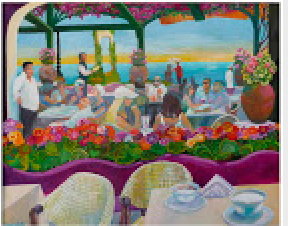
Because of my passion for art, I bought some pictures by artists that exhibited in Woking. The cover picture of my collection, Negotiating Caponata, is from a painting by Janice Dempsey (https://www.janice-dempsey.com/  https://www.janice-dempsey.com/italy.html ), ‘Cappuccino in Positano’, a gouache that now hangs proudly in my living room. 

I also bought an abstract painting by Geoffrey Pimlott, ‘Cadmium yellow below


black’(http://farm5.clik.com/geoffreypimlottarws/), a piece I really like, from his last exhibition at The Lightbox that unfortunately lasted only a few days due to the lockdown. I reviewed the exhibition here: https://wokingwriters.wordpress.com/2020/03/23/two-painters-at-the-crossroads-geofrey-pimlott-and-colin-merrin-the-lightbox/ I love the way Geoffrey uses the ochre and black together with pink and yellow. The juxtaposition of colours gives me joy and makes me think of the positive side of life. 

Hannah Bruce is very active in Woking Art Society (https://www.artfinder.com/hannah-bruce?gclid=EAIaIQobChMI1Iyz9PPy6wIVVObtCh0DQA6UEAAYASAAEgIx7fD_BwE#/); she regularly exhibits in the area and her work expresses the right balance between figurative and abstract. I chose ‘Cat peeking’ among her beautiful pictures for its warm colours and the skilful use of watercolours and inks. 


Finally, I bought Liz Seward’s ‘Virginia Water – Autumn’ (http://sewardart.co.uk/liz-seward/) in watercolour at the Peacock exhibition. I attended one of her workshops with WAS before the lockdown and admired her way of teaching and her paintings. She uses watercolours with expertise, exploring the transparencies of the medium. I love this piece because of its freshness and delicate tones.


Crocheting is one of my passions. I experimented new patterns such as the mosaic pattern and new granny squares with the help of tutorials of Ophelia Talk crochet I found on Twitter. I made potholders and face masks and am planning to make a blanket for Violetta too. I quite like wearing face masks and matching them with my outfits. That’s why I created some handmade ones with fabrics and crochet. If they are too thick I feel short of breath because of my asthma condition, but the crocheted ones are perfect. 


The V&A sent me links of sewing patterns such as Mary Quant ‘Georgie dress’ and the Japanese style ‘boro’ bag, which I made. Here are the links:  

https://www.vam.ac.uk/articles/sew-your-own-mary-quant-georgie-dress?utm_campaign=1378971_Membership%20Monday%20Fashion%20email&utm_medium=email&utm_source=Victoria%20%26%20Albert%20Museum&dm_i=45GA,TK0R,AGDPP,3KP8V,1 

 https://www.vam.ac.uk/articles/make-your-own-japanese-boro-bag?utm_campaign=1378971_Membership%20Monday%20Fashion%20email&utm_medium=email&utm_source=Victoria%20%26%20Albert%20Museum&dm_i=45GA,TK0R,AGDPP,3KP8V,1


The ‘boroboro’ bag, which means ‘something tattered or repaired’, is a re-working of pre-existing materials sewn together and then embroidered with simple stitches. I made two and added my Italian touch crafting a more complex kind of embroidery and interweaving figurative patterns with abstract ones. The V&A also sent me videos about its collections, fashion, handmade crafts, such as crochet, jewellery making, illustration and the fantastic kimono exhibition, which had to close because of the Covid-19. Here are the links:  

Part 1 

https://www.youtube.com/watch?v=oEf0iFNTVGw&utm_campaign=1397082_Members%27%20Week%20-%203%20-%20Wednesday%20-%20Fabulous%20Fashion%20email&utm_medium=email&utm_source=Victoria%20%26%20Albert%20Museum 

Part 2 

https://www.youtube.com/watch?v=hG6UVZexmc8&utm_campaign=1397082_Members%27%20Week%20-%203%20-%20Wednesday%20-%20Fabulous%20Fashion%20email&utm_medium=email&utm_source=Victoria%20%26%20Albert%20Museum  

Part 3 

https://www.youtube.com/watch?v=dvyC_pqYhvw&utm_campaign=1397082_Members%27%20Week%20-%203%20-%20Wednesday%20-%20Fabulous%20Fashion%20email&utm_medium=email&utm_source=Victoria%20%26%20Albert%20Museum  

Part 4 

https://www.youtube.com/watch?v=oz1AzscxHjk&utm_campaign=1397082_Members%27%20Week%20-%203%20-%20Wednesday%20-%20Fabulous%20Fashion%20email&utm_medium=email&utm_source=Victoria%20%26%20Albert%20Museum  

Part 5 

https://www.youtube.com/watch?v=OSgNdkcg9To&utm_campaign=1397082_Members%27%20Week%20-%203%20-%20Wednesday%20-%20Fabulous%20Fashion%20email&utm_medium=email&utm_source=Victoria%20%26%20Albert%20Museum  

Eventually, I could attend the exhibition at the end of August and reviewed it here: 

https://londongrip.co.uk/2020/09/kimono-kyoto-to-catwalk/?wppa-occur=1&wppa-cover=0&wppa-album=185&wppa-photo=3433 


I attended some online events with Canada-UK Foundation too about Canadian ethos, the effects of the pandemic on economy, business and education and how to recover from this situation. I took part in Canada Day in a virtual pancake breakfast and also wrote a prose poem on it:  

Canada day  

It had been a long day at the computer and then preparing dinner, peeling potatoes, washing salad and tomatoes, chopping carrots, frying meatballs then laying the table. What day was it? Monday or Wednesday? The last day of the month or the beginning of a new phase? I lost track in isolation. I began to think that maybe, just maybe there might be something for me, just for me on the doormat. How else to explain this sensation of novelty? I unlocked the door and there it was, a parcel tightly wrapped in grey plastic. I tore it open and a box with a red maple leaf printed on the top appeared. Inside a bottle of pure Canadian maple syrup and a packet of flour mix for buttermilk pancakes. ‘Dear Carla’, it began, ‘Happy Canada Day!’  


From time to time I enjoyed music with the Philharmonic Orchestra and the Royal Opera House online events, and ‘The Story of Anansi’ with the Unicorn theatre, an entertaining show for children, but very involving. I had great fun, here are the links:  

https://www.youtube.com/watch?v=2glXMWbHTxg  

https://www.youtube.com/watch?v=g-NTeNV2OkA 

https://www.youtube.com/watch?v=2glXMWbHTxg  

https://www.youtube.com/watch?v=kZLoomnoFmQ&feature=youtu.be


Shena Grigor, one of my yoga teachers, organised yoga sessions at Woking park on Saturday and Sunday afternoons. It was so exciting to meet people again and exercise outside in the sun or under trees if it was too hot. When the leisure centre opened again, I could also attend yoga with Sandra Cooper though spaces are restricted and the course fills quickly.   


Unfortunately, with autumn coming it is getting colder and we have to stay inside hoping that the freedom we have gained after summer is not taken back again due to a second wave of the virus. I try to be realistic, keep things small in everyday life and not plan ahead more than one or two months. Though the Government’s rules may be confusing sometimes (which I believe is not a characteristic of the British situation but is global), I believe it is important to follow them. The basic rules such as ‘wash hands, cover face and make space’ are fundamental. Then stay hopeful, keep in touch with friends and family and look after each other if possible. A good recipe for survival.

Sunday, 13 September 2020

Coronavirus diary: recovery and planning ahead

 Here I am again after the summer break where everything seemed static but actually a lot of things happened behind the scenes both in my life and internationally. The pandemic should have been a restrain but it wasn’t in the face of serious events such as the death of George Floyd, the manifestations that followed, which rightly expressed the issue of discrimination against black people, and the Beirut explosion. From my isolation and consequent staycation, I couldn’t help feeling worried and helpless but I am also aware that I can voice my opinion in writing and in everyday life. It is a little contribution but as Madre Teresa of Calcutta says: ‘We ourselves feel that what we are doing is just a drop in the ocean. But the ocean would be less because of that missing drop.’


August was dedicated to my PhD thesis on Margaret Atwood, the title is: An intertextual reading of female characters in Margaret Atwood’s work. The proof-reader gave me some deadlines and my supervisors wished to have a semi-final draft by the end of August. So, I concentrated all my energy on writing and eventually finalised 87,000 words. It was hard work and a big effort but I’m so happy to have accomplished it according to my plans.


When the restrictions of Covid-19 eased off, we managed to visit my son Lorenzo and my daughter in law Layla in Leeds and my autistic daughter Valentina in Doncaster. The great exciting news is that Layla is pregnant and I will be grandma before Christmas! She should be a girl, Violetta, and I am already preparing knitted and crocheted things for her in white, pale pink and purple. Lorenzo and Lyla are overjoyed, of course. She had some low blood pressure problems at the beginning of the pregnancy but is now fine.


My daughter Valentina is all right too. The social services have just moved her south near Redhill so we can visit her more often. She is settling in the new accommodation with new staff, which is not an easy matter for her, but we can see her every week now and she is so happy when we are there. We always bring her new clothes, the sweets she likes and the things she buys online, usually Futurama items.


I also started my new job at ISL London, an international school in Hammersmith. I teach Italian language and literature to MYP and DP students, that is, high school students, according to the International Baccalaureate program. Commuting to London is not so easy, it means leaving home at 6 am to avoid the traffic and coming back home after 6 pm. It is a major commitment and a big change from my previous routine. I work three days a week in London while my husband works full time in the same school. Luckily he is the one who drives, so I can read or have a nap during the commute. Earning money is good and rewarding and I love having contact with students again. The environment at ISL London is welcoming both for staff and students; the international atmosphere makes you at ease and is very friendly. On the whole I like this opportunity and hope to make the most of it, and, at the same time, I will try to keep on track with my creative side.


We also visited my son Francesco who moved to Newcastle to start a teaching job in a high school as a maths teacher. He is sharing an apartment with some friends and seems very happy with his new situation. Here is a poem I wrote for him before he left:


Newcastle


For Francesco


I hope your road is a good one

full of unexpected discoveries,

paths you’re exploring for the first time

where dragons and kind elves mix.

You enter a new environment

a school where you will teach maths

to disadvantaged children, KS 3 and 4,

where you will meet the unlucky ones

who will never access Oxford as you did,

who maybe are not as talented as you are

in painting, music and writing,

or excel in Physics and maths,

or understand Nietzsche’s and Kant’s thoughts.

Moving there is your choice

away from the too caring Italian family

to learn life from scratch, the ‘real’ one

after the university bubble.

Keep Newcastle in your heart and mind,

it will make you rich.


During the lockdown I gained three kilos and managed to lose two very slowly thanks to some good advice from nurse Emma who is monitoring my diabetes 2 condition. I crave biscuits and chocolate but I try to stick to my diet as much as possible. Despite this, I still baked but mainly experimented new savoury recipes as a pastime and also to give a bit of taste to the dullness of isolation. I will post the new recipes in the autumn blog.


I also took part in the Woking Art Society’s exhibition at the Peacock centre in Woking. It lasted two weeks and was a great experience. Being part of an art group motivates my artistic side. I feel I can produce more and develop further. It was also an opportunity to compare my work to other artists’ of the group that had their work on display too. I am working on kimono patterns at the moment inspired by my travels in Japan and by the exhibition at the V&A, Kimono: Kyoto to Catwalk. Art has no boundaries and you can express yourself in whatever ways and whatever style you like. This is liberating and releases frustration as well.


Online classes and zoom sessions were a great opportunity to keep in touch with fellow writers and also produce creative work. I attended art classes with Grainne Roche and poetry classes with the Poetry Business as well as open mic sessions with 1000 Monkeys, organised by Dempsey&Windle, and Write Out Loud zoom nights. It was a bit hectic at certain points when some events overlapped and I was having most of my evenings booked. I had to cut some of them in September when I started to work at ISL London.


On TV I watched the young Montalbano season two and Mrs America with Kate Blanchett on BBC 2 and the brilliant Talking Heads on iPlayer, all great fun. A lot of my time was dedicated to planting and growing my trug vegetable garden and arranging new flower pots. I had some good harvest from time to time thanks to the sunshine and a bit of spring rain. We could savour fresh salad and cherry tomatoes as well as courgette and beans.


I feel I am on a recovery plan and though things are not back to normal (but what is ‘normal’?), it is getting better. Is a new coronavirus wave coming soon? Are we going to celebrate Halloween and Christmas as usual? I hope so. More of my summer and my present days in my next posts.


Friday, 10 July 2020

My summer holidays during the pandemic


The pandemic caused such a change in our everyday life and we had to accept it silently. The closure of shops, staying at home, social distancing and strict hygienic measures were not so easy to cope with. It wasn’t a big problem for me at first as I had a lot of work to do from home for my PhD and my writings as well as other hobbies, but in the long term it was wearing. I longed to go out, visit shops, museums, places that would inspire me, distract me from routines, that gave me a change. I followed events and meetings online but it was not the same as meeting people in person. Virtual meetings were interesting, sometimes involving, but going out, talking with someone physically in front of you is another thing. However, it was intriguing to have a peep in other people’s houses, the
pictures in the background and book shelves. Were people sitting straight in front of the screen or slouched on a sofa? Watching a virtual exhibition or a theatre performance on YouTube is better than nothing but it is not comparable to going to the museum or to the theatre. The emotions you feel looking at pictures, outfits or other objects on display, observing them from different angles, lingering and absorbing what they communicate cannot be replaced by a short quick video. Going to the theatre is such an involving experience; the atmosphere of the live performance even watched from the upper circle where I usually book my tickets is thrilling. This also includes the pleasure of dressing up for the occasion, meeting people, having an ice cream or a drink. In the long term, online events are like surrogate or tasteless food, sort of pills or dehydrated tablets that might give you the necessary calories but don’t give you the flavour of the real thing. A dish of bucatini all’amatriciana is not the same as an energy bar.


We had to change our holiday plans too, of course. I had planned to spend at least a month in Canada attending a conference at London Ontario and then carrying on with my research on Margaret Atwood at the University of Toronto. I had also planned to meet my Canadian friends in British Columbia, but the conference was postponed to June 2021. In Canada there was a lockdown as well and my friends were in quarantine. The same happened for another conference I had at the University of Göttingen. My flight to Italy was cancelled too and I don’t dare to book a flight in August. My mum turned ninety at the end of May and I was sorry not to be there. We had a long conversation and a big hug through the phone screen. She told me she is knitting a blue scarf for me and insisted that I should go to Rome to see it. I said I will, as soon as the lockdown eases off, but I don’t feel safe to travel to Italy now. I haven’t seen her since last Christmas, I miss her and the rest of my Italian family. My children phoned her too to wish a special happy birthday but it was a bit sad not to be there altogether to celebrate such an important achievement.

I feel afraid to move out of my area. I think the risk of infection is still there though the death toll and the contagion have decreased drastically in the last few months. I feel that a lot of imprecise information is going around so it is better to stay safe at home. Besides, experts say there might be another wave of the coronavirus in autumn, so I suppose I won’t leave the UK before Christmas. It is frustrating not to have a proper break, not planning or looking forward to a change; the future looks flat. I cannot see a difference, a stimulating alternative to what I am doing and living every day. I hold on to the deadlines for my thesis and my writings trying not to neglect my creative side, which gives me a vital support. The good weather is helping but I am not taking much advantage of it though my garden is blooming.


My husband and I are planning some trips in the nearby areas, Surrey Hills, Winchester, Salisbury and the seaside, maybe in Devon or in the south coats. Only one-day trips as I don’t feel comfortable to rent a house, even for a few days, I prefer to go back home at the end of the day. From 1st June we were allowed to visit my autistic daughter Valentina who lives in a residential school near Doncaster, only for two hours and in the open air wearing PPE. I really missed her. We skyped with her once a week during the lockdown but we didn’t really interact with her as she doesn’t speak though she was always happy to see us and sent us kisses through the screen.


Maybe to experience something different I am thinking of planning a tour of the imagination to stimulate my creative side with new books, images, stories and music. The best way to do it is avoiding a precise target, do it loosely without a deadline, just doing it for the sake of it, for pure pleasure. It is also important to do it when I feel like it in order to relax, to have a break, to break free. In this time, it can be a way to grow and survive emotionally.

I baked like mad and still doing it, another way to relax and nourish myself. Dinners seemed such an important moment during the lockdown. We gathered at the end of the day with a steaming minestra or tortellini with cream and tomato soup and had a chat. I experimented with new recipes, prepared delicious Italian dishes trying to use less fat and less sugar as I kept on gaining weight. The doctor recommended me to lose weight six months ago and I felt guilty I gained two instead. I was desperate but there was no way to make the arrow of the scale move a bit towards the left, and there’s no way to cheat. So I bought larger clothes, long loose dresses, fresh and comfortable to wear and new earrings to match. Some good recipes came out though; here are the results of my efforts in the kitchen:

Treccia (braid-shaped stuffed bread)

You need: 500 g of flour, two tbsp. extra virgin olive oil, 250 ml of lukewarm milk and water, one tsp of salt, 7 g of dried yeast, 100 g of prosciutto or bacon cut in pieces, 100 g of grated mozzarella or cheese, one beaten egg to brush the top.

Mix the flour, salt, yeast, olive oil, water plus milk and yeast. Knead the dough and let it rest in a warm place for 2-3 hours covered with a wet tea towel. When it has risen to twice its size, knead the dough again and divide it in three parts. Roll out the three parts of dough in stripes and spread the mozzarella, or cheese, and the prosciutto, or bacon, on them. Fold the stripes over and interweave the braid with the three parts of dough. Set the bread on a greased oven tray, cover it with film and let it rest in a warm place for half an hour.  Finally, brush the top of the bread with a beaten egg and bake it at 200°C for forty-five minutes or one hour.


Tiramisu with strawberries

You need: 250 g of mascarpone, 200 g of strawberries, 3 medium eggs, four tbsp. of sugar, 300 g of rich tea biscuits or savoiardi, some coffee.


Cut the strawberries in small pieces but keep a few of them to decorate the top. Prepare the cream beating the egg yolks with the sugar, add the mascarpone and the whites whipped stiff. Then add the strawberries. Spread two or three tbsp. of the cream on a square bowl then set the layers of biscuits and cream. Dunk the biscuits in coffee and set the first layer then cover it with the cream. Carry on with a layer of biscuits and a layer of cream finishing with the cream. Decorate the top with strawberries cut in half and chill for 3-4 hours before serving.

Tart with strawberries and cream

For the dough you need: 200 g of self-raising flour, 50 of cocoa, 50 g of dark muscovado sugar or brown soft sugar, one egg, 70 g of melted butter.

For the filling you need: 250 g of ricotta, 150 g of caster sugar, 250 ml of double cream or whipping cream, 300 g of strawberries. Dark chocolate chips to decorate.

Prepare the cream mixing the ricotta with the sugar and chill it for two hours. Add the whipped cream and chill for two more hours.

Prepare the dough mixing all the ingredients and chill it for half an hour. Roll it out and line a greased tart pan with the dough. Bake it at 180°C for half an hour.

When it is cool cut the strawberries in small pieces, but keep a few of them to decorate the top, add them to the cream and spread the cream mixture on the tart. Decorate the top with chocolate chips and chill for one hour before serving.

Porridge muffins

You need: 300 g of porridge oats, one banana, 100 g of flaked coconut, one tsp of baking powder, one tsp of vanilla extract, 100 ml of soya milk, 3 tbsp. of honey, two eggs, 200 g of fruit (I used plums cut in small pieces, but it can be blueberries, peaches or whatever fruit you like).


Cook the plums with a tbsp. of Demerara sugar until boil and leave it to simmer for ten minutes. Mix all the other ingredients in a bowl and then add the plums. Pour a full spoon of the porridge mixture in cupcake cases and bake at 180°C for half an hour.

Porridge pie

For the dough you need: 250 g of self-raising flour, two eggs, 70 g of sugar, three tbsp. of canola oil or sunflower oil.

For the filling you need: 250 g of porridge oats, two eggs, some fruit (I used three peaches and four apricots cut in small pieces).

Prepare the dough mixing all the ingredients, knead it and chill it for half an hour. Cook the fruit with two tbsp. of Demerara sugar until boil and leave it to simmer for ten minutes. In a bowl mix the porridge oats with the eggs and the fruit. Roll out half of the dough and line a pie dish, pour in the fruit and porridge mixture and cover it with the rest of the dough. Bake at 180°C for half an hour-forty-five minutes.

I dressed in red to celebrate Canada day virtually with the Canada-UK foundation on Zoom. They organised a pancake breakfast with interesting speeches on the Canadian values of diversity, multiculturalism and tolerance, and a quiz. We sang the national anthem as well. They sent me a parcel with Canadian products from www.puremaplesyrup.co.uk . During the day, I made some biscuits from recipes I already had, using peanut butter and maple syrup. I posted the peanut butter biscuit recipe last year here: http://carlascarano.blogspot.com/2019/12/canadian-recipes-with-italian-twist.html


And here is the recipe for the Maple syrup cookies:

You need: three tbsp. of maple syrup, three tbsp. of canola oil, 150 g of self-raising flour, 100 g of porridge oats, 100 g of golden granulated sugar, one egg.

Beat the sugar and the egg, add the other ingredients and knead the dough. Let it rest for half an hour then roll it out and cut the patterns using a biscuit cutter or make small balls and press them with a fork. Bake the biscuits on a greased oven tray at 180 for ten-fifteen minutes or until ready.

Have a good summer time, I will be back with my blog posts in September.